


By Rose Simpson
Like most people, I spent half my life taking my pelvic floor for granted. For years, I bopped around the tennis court like nobody’s business. I played basketball and the only dribble I had was on the court. And sex, well, I never had any problems in that department.
 Then I hit perimenopause, or should I say, perimenopause hit me. My regular morning tennis matches meant one, maybe two, changes of the tennis underwear beneath my skirts (thank God for skirts!). And one time, a competitor mentioned a funny smell when she walked behind me going to the bathroom. I was so embarrassed, I quit a sport I had loved since I was a teenager.
I can’t blame my under-carriage. After carrying three babies in five years, my once supple pelvic floor —the trampoline that holds up my bladder and other vital organs—had stretched to its limit. By the time I reached actual menopause, the leaks became worse and required at least $1000 a year in paper products to keep my dignity intact. No amount of kegel (pelvic floor) exercises could keep me from leaking or sleeping in a wet spot after coughing.
I’m not alone. One in four women will experience urinary incontinence (UI) during their lifetime while one in 10 men will suffer from it. According to the Canadian Continence Foundation, urinary incontinence affects one in five Canadians over 65 and can cost up to $1,500 just for pads alone, not to mention pee-proof panties.
What’s worse, UI does a real number on a person’s confidence and quality of life. In a survey among almost 800 Canadians experiencing incontinence, 90 percent report that incontinence has an impact on their overall feeling of well-being, and over 80 percent report feelings of embarrassment and frustration.
My Quest for a Cure
Like many women, I looked for help everywhere. I talked to my doctor who merely shrugged and suggested bladder leaks were a product of aging. She recommended doing pelvic floor exercises which left me frustrated; no matter how many times I clenched on the toilet, the pee just dribbled out, somewhat joyfully, mocking my efforts.
So I decided to get a second opinion. I searched Doctor Google for solutions. Following YouTube video instructions, I constructed something that involved a sterilized Kinder Surprise egg filled with pennies attached to some fishing wire. Don’t ask. The best part was eating the chocolate.
This year, I found hope.
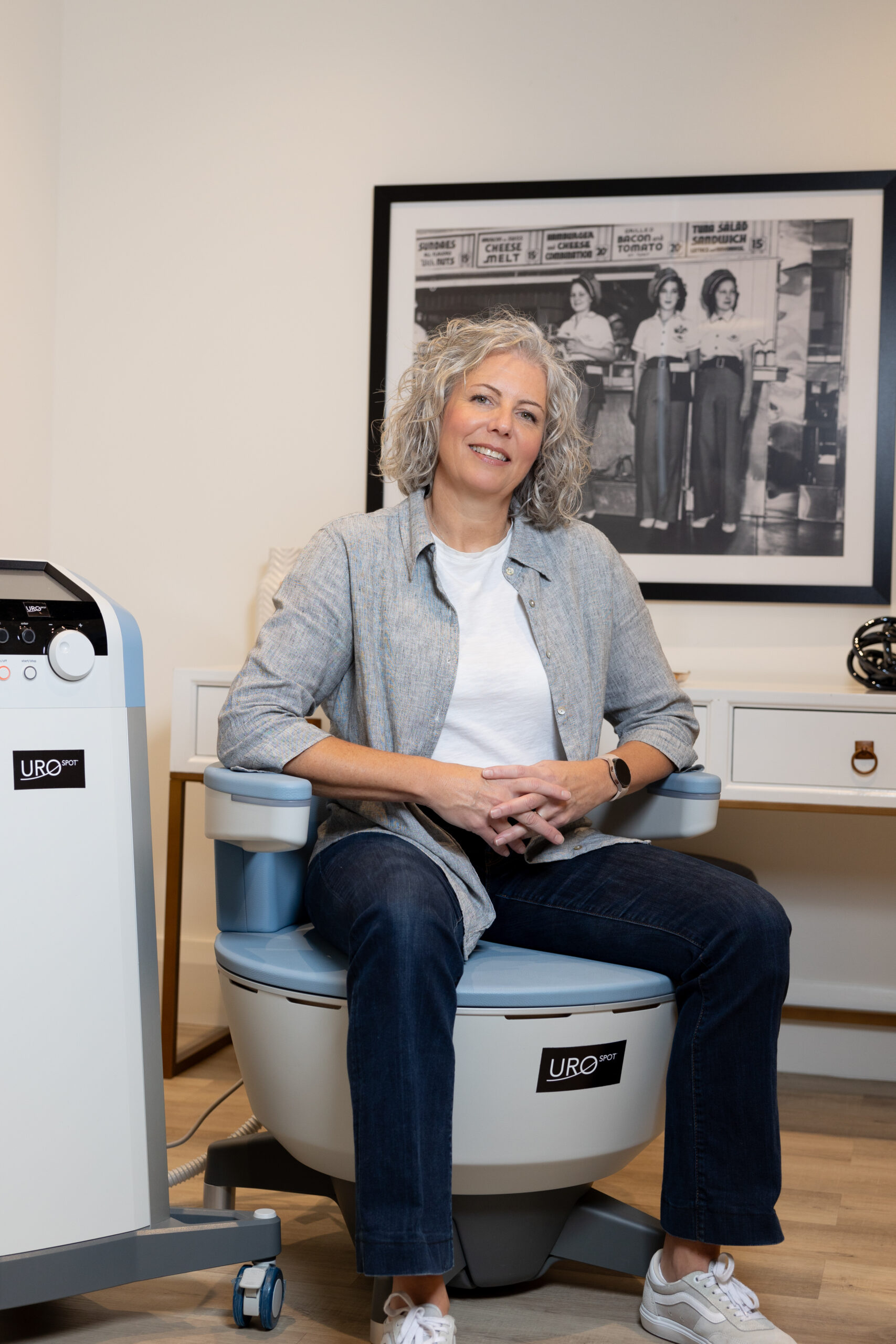
I saw an advertisement for UROSPOT, a company that promised to end my dribbles once and for all. The evidence-based treatment involves squatting on something called The Throne, which delivers the equivalent of 11,000 kegels in a single session. Its six-session treatment plan promised to strengthen my pelvic floor thus keeping the dribble at bay.
I’m in, I thought, as I skipped in for my first consultation. I met with Kris Ouimet, the delightful owner of two UROSPOT franchises. A mother of four, Kris left a successful career in pharmaceuticals and joined the London, Ontario-based company after reviewing the clinical research. She was convinced that UROSPOT could help women with stress incontinence, pelvic organ prolapse and other issues, as well as men who suffered from erectile dysfunction, nocturnal bathroom issues and those who were recovering from prostate surgery.
Kris introduced me to UROSPOT’s team, which included a nurse and physiotherapist who took my medical information and determined I would be an excellent candidate for the program. Not everyone gets the green light. The “throne” is not recommended for those who have had a hip replacement or pacemaker. Nor is it for pregnant women and those with copper IUDs. It’s also best to consult a doctor before proceeding.

The six treatments involve straddling a chair, fully clothed, and leaning forward so the machine can work its magic on the perineum area which is the tiny space between the vagina and anus. Each treatment takes 28 minutes. The chair pulses at various strengths and sort of sounds like a jackhammer. It doesn’t hurt; in fact, it’s sort of calming like a massage chair.
Perhaps the best part of the treatment is watching a series of videos hosted by medical professionals who educate the patient about their condition. The video explains why urinary incontinence is even a thing and provides strategies on how to train the patient’s bladder to work better.
For example, did you know that you’re not supposed to run to the bathroom every time your bladder gives you the appropriate signal? Or jump to attention in the middle of the night the minute you get the urge? The bladder is not designed to boss you around. It’s supposed to hold urine for at least two hours during the day and overnight. If you give in, it simply takes advantage of your good nature—well that’s how I understand it.
I talked to several patients, including men who were having treatment, and they raved about their UROSPOT experience. Some said they had been able to reduce their dependency on pads and liners. One man said he was sleeping better because he didn’t have to get up every hour to pee. Most patients talked positively about the medical education that accompanied their treatment.
Did it work for me? So far so good. I am taking the advice seriously and working to get my bladder/pelvic floor in better shape. I have fewer accidents and I am resisting the urge to run to the bathroom every time I run the water. Best of all, I have completely dry pants!
Time will tell of course, but I’m gratified that the nurse will follow up in case I have further issues.
At about $2,000 (half is covered by private insurance for physiotherapy), UROSPOT is not cheap, but considering what I have spent on paper products, undies and laundry over my leakage lifetime, I believe it’s good value.